Gary Zed may have started his career in professional services, but it was his love of nature that catapulted him into a new realm of business opportunity.
Get Instant Access to This Article
Become an Ottawa Business Journal Insider and get immediate access to all of our Insider-only content and much more.
Gary Zed may have started his career in professional services, but it was his love of nature that catapulted him into a new realm of business opportunity.
After nearly 30 years with organizations such as Deloitte, EY and KPMG, Zed decided to try something new and in 2019, with deforestation concerns top of mind, he founded Canada’s Forest Trust Corp., an Ottawa-based social enterprise that offers a six-phased approach to tree-planting programs with digital tools that track and measure environmental impact. It works with businesses to help position them as leaders in climate action through solutions such as a corporate stewardship model where businesses make financial contributions, employee engagement campaigns, and point-of-sale programs that invite customers to contribute at checkout.
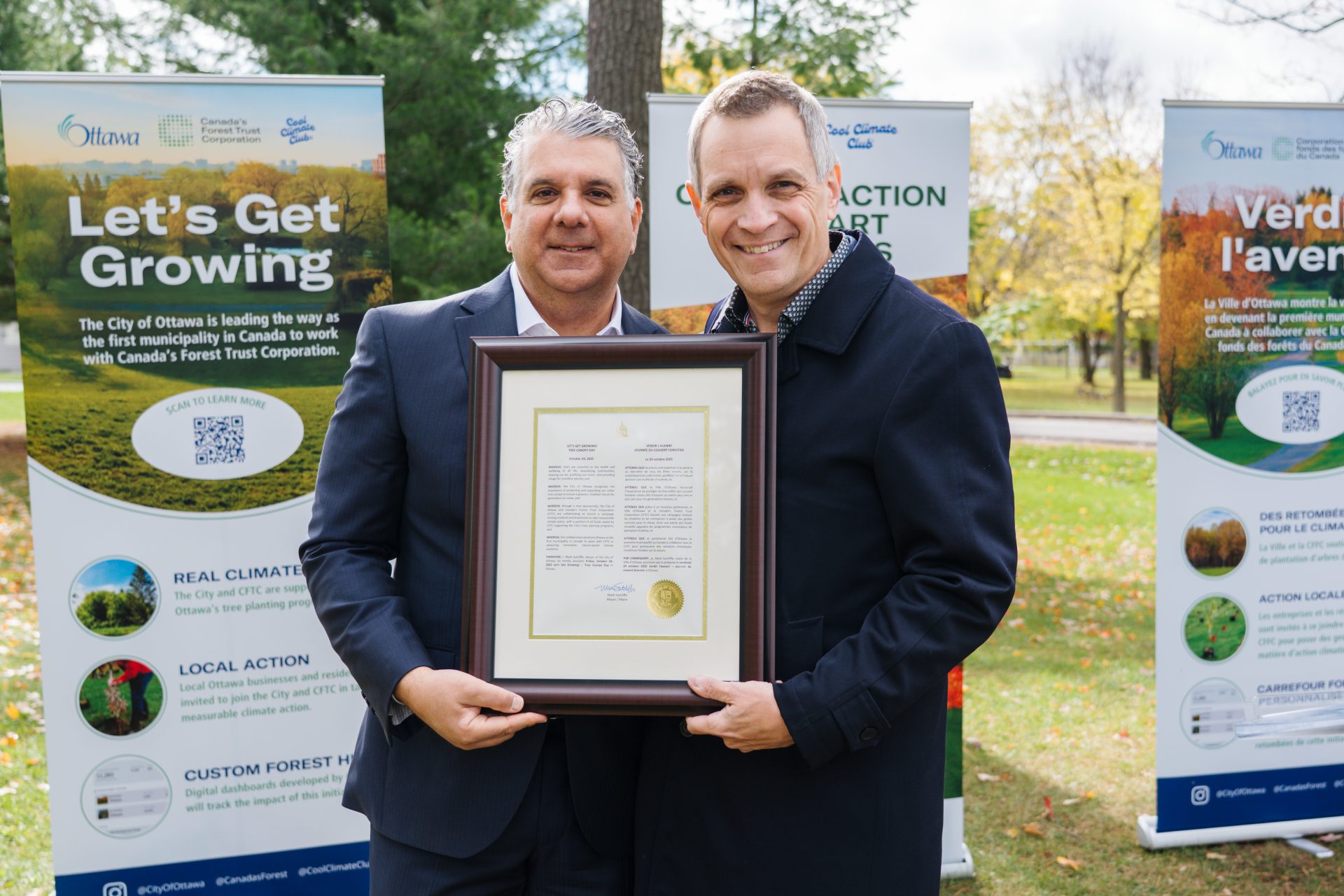
Now, six years later, Zed is expanding his efforts. On Friday, his organization announced a new partnership with the City of Ottawa to launch the "Let’s get growing" campaign. Billed as part of Ottawa’s wider climate pledge, the initiative is the first of its kind in Canada, designed to support the city's re-greening efforts and improve its tree canopy, Zed told OBJ.
In this Q&A, Zed talks about his decision to start Canada’s Forest Trust, why businesses need to care about climate change and what they can expect from this new campaign in Ottawa.
This transcript has been edited for length and clarity.
Why did you decide to make the leap from professional services to commit to this work?
I’ve always been a big believer in giving back to the community and I think my history of loving nature and being in nature kind of brought it to bear. In my former professional life, I spent an incredible amount of time with some of the wealthiest Canadians and Canadian families and they all had, as part of their platform, the need to think about their environmental impact. It was through that lens that I said there was a significant amount of opportunity to really help out Canadians, to build a great business and, at the same time, do some good for the world.
How and when did this become an issue that you care about?
I grew up in New Brunswick and I love fly fishing and salmon fishing. Many of my friends in Ottawa have been to my fishing camp in New Brunswick and what we’ve observed over the years is that there’s been a real impact on the salmon rivers because of over-cutting and clear-cutting. That’s had a real unfortunate impact on the salmon run and it’s been devastating. My forester said to me, ‘You should start buying land.’ So what I started to do was buy 100 acres, 500, 1,000, then tens of thousands of acres of land to basically preserve it, protect it and reforest it.
Then I realized that climate change wasn’t just about me. It’s on every business and, frankly, every individual. So I thought, why not convert the idea of replanting and make it available to customers and really build a business around it? It’s a business imperative. Most people don’t think about climate action as good for business, but what’s happening in Ottawa is that business leaders and businesses are really not prepared to respond to the new generation of climate-conscious consumers and employees and customers.
There’s a very powerful gen Z and gen alpha — and, to a degree, millennial — cohort that has value sets and expectations that prioritize climate action and nature. There’s very consistent polling that over 70 per cent of employees expect their employer to have a climate plan. Seventy-six per cent of consumers don’t want to buy from organizations that don’t have a plan. And if you’re dealing with a very young cohort, like the 35-year-olds and under, you’re dealing with climate anxiety.
Through that lens, you understand that it’s smart business to actually get engaged in climate strategy. But the dilemma has been that businesses just don’t know what to do. So we’ve developed what I think is a very succinct, easy, turnkey program for virtually every Canadian business to get engaged around climate change and to help deal with the imminent problem that’s before them.
Tell me how this campaign with the city fits into that mission.
It’s the first of its kind in any municipality and, frankly, it’s really a slight pivot from what we’ve been doing across the country. It’s about ensuring that when local businesses invest in a climate program with us, that investment stays in Ottawa. In other words, it’s buy local, plant local.
We build forests for customers and corporate stewards across Canada, but they can’t see it because it’s potentially 100 or 500 kilometres away. In the Ottawa context, we’re saying every Ottawa business, family or resident who wants to have a climate plan and a climate profile can be assured that we’re going to keep that money local and we’re going to invest that with the City of Ottawa to help out our tree canopy.
Will you be looking to expand the campaign to other cities?
We currently operate in seven provinces, but Ottawa is obviously our home. We have plans to look at subsequent partnerships on a community level with other cities and we’ve already been reached out to by two other larger communities to expand this idea of "Let’s get growing." You’ll basically see significant campaigns, having people focus in on climate strategy, and letting us help them build out a custom program to position themselves as leaders. It doesn’t mean investing tens of thousands of dollars. Some are investing $500 or $1,000.
We believe most cities in this country will see it as very innovative, forward-thinking and a new way of identifying revenues for the city at no cost to the city. That’s the big thing to keep in mind. The city has limited budgets for forestry. What we’re doing now is basically saying, ‘We’ll give you the funds that you otherwise wouldn’t have to expand tree canopies in your communities.’ It’s not going to cost the city anything in terms of budget. On the other hand, you’re going to have retailers and professional services firms saying they’re happy to chip in.
In six months, we’ll definitely be in two other cities but we want to make sure we do the job right and well in Ottawa.
Plenty of organizations that deal with climate change and reforestation are non-profits. Why did you decide to structure your organization as a business?
We look at our business as a social enterprise and a not-for-profit structure would not enable the capital required to have real impact. There is a $10-billion opportunity before us, just in Canada alone, around carbon and reforestation projects. To unlock the trillions of dollars of transactions and opportunities that exist in our country alone requires a structure that is far more commercial and capital-focused. We are able to invest heavily in our technology. We’re able to invest heavily in long-term investments. We’re able to invest heavily in buying land and getting into partnerships. Those are things that you just can’t do in a not-for-profit model.
The vast majority of the money that we generate will be going back to the community. In the case of Ottawa, the money goes back to Ottawa. You can get yourself handcuffed with a not-for-profit model and the climate issues that are before us require a lot of innovation, a lot of technology, a lot of business risk that you just would never be allowed to do.
Instead what we do is partner with a lot of not-for-profits to help with their strategies and find collaborations. We don’t want to be reinventing the wheel. There are organizations like Forest Canada that we work with. We don’t need to be duplicating the great work that some of those organizations are doing. We have found the sweet spot to look at is as a business and look at where the business opportunities are to develop the marketing, the infrastructure, the back-end technology that’s needed to execute and deliver the programs that the business community is going to want to have.
For small and mid-sized businesses that might not have as much wiggle-room in their budgets, why are climate initiatives like this worth investing in?
I would say, firstly, that it’s a business imperative. Secondly, it’s going to attract more customers and more brands to their organization. As we build out our partnership with the city, we’ll be talking about green employers, green businesses, a green directory to really try and create that sense of community. Everything that we do is scalable and every business can find a way, with their budget, to get engagement. You don’t have to be the largest business in Ottawa to be participating. And, frankly, a number of the businesses already on board in Ottawa are the SMEs. They’re some of the smallest businesses in the city today and they’re already lining up to get engaged.
It could be a small retail store, a clothing store, a delivery company. We create a very frictionless, barrier-free type of environment for every business to find a home in terms of taking climate action. It’s really about educating them. It’s good for their bottom line, good for their brand, and it’s as much a marketing and branding expense as it is a climate action.