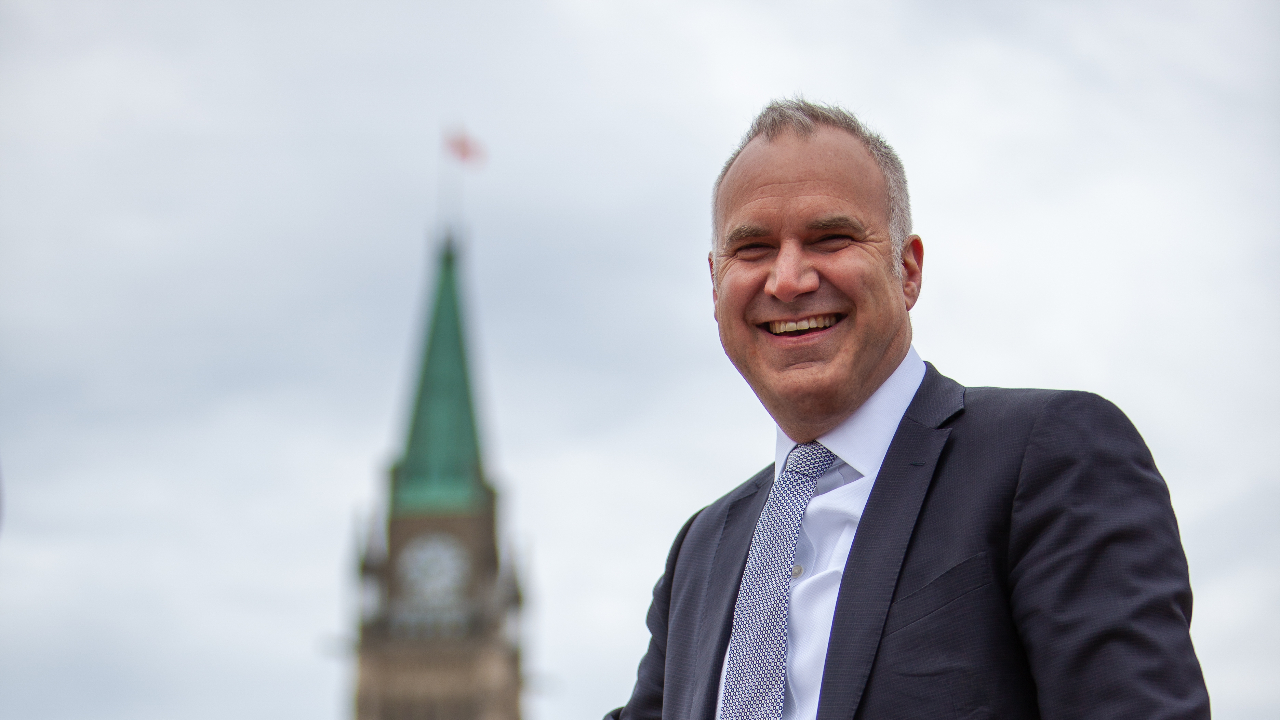
From LeBreton Flats to the Rideau Canal, and from Westboro Beach to Kìwekì Point, the National Capital Commission plays a key role in the vibrancy and economic health of the National Capital Region. This past year alone has featured many successes, including a land deal with the Ottawa Senators at LeBreton Flats and an unexpectedly […]
Get Instant Access to This Article
Become an Ottawa Business Journal Insider and get immediate access to all of our Insider-only content and much more.
From LeBreton Flats to the Rideau Canal, and from Westboro Beach to Kìwekì Point, the National Capital Commission plays a key role in the vibrancy and economic health of the National Capital Region.
This past year alone has featured many successes, including a land deal with the Ottawa Senators at LeBreton Flats and an unexpectedly popular opportunity to swim at Dow’s Lake.
Still, the NCC is often the Crown corporation that many Ottawans love to hate.
To better understand the NCC’s evolving approach to the city and to learn more about what’s to come in 2026 (hint, look for more swimming holes), OBJ sat down with Tobi Nussbaum, almost a year into his re-appointment as the head of the NCC.
The transcript has been edited for length and clarity.
Q: Looking back at 2025, what are three things that went well or that you are proud of?
“When I look back at 2025, I think of the number of public assets we opened, with a real focus on shoreline and waterfront activation. The three assets in particular that I think received a lot of very positive public response include Kìwekì Point, which is the new public park on the river side of the National Gallery; the Westboro Beach revitalization, which saw the introduction of much better amenities, recreational facilities and a café and restaurant; and the third, which exceeded our expectations, was the pilot on the Dow’s Lake swimming area. We did it with our eyes wide open and not knowing whether it would succeed or fail. There was at least a willingness to try there, but I think it exceeded our expectations in terms of the public participation and response.
“There are some other things that happened that I am proud of, which are going to have a little bit more of a downstream impact on the capital. We were very pleased to see progress on the former Chapters site with Live Nation. Work started in 2025 with the goal of opening up a new cultural venue in 2026. It gets to the NCC’s commitment to work with other partners in the nation’s capital on downtown revitalization. We think it will have a positive impact on the downtown and particularly the ByWard Market. The other thing is the fact that we have an agreement of purchase and sale with the Ottawa Senators (on the LeBreton Flats project). The fact that that was completed in 2025 was an important milestone.”
Q: What do you think could have gone better or be improved upon in 2026?
“First off, we’re very open at the NCC to the idea that we can do better. We are imperfect like everyone else and we have tried to inculcate a culture of innovation and of trial and error. There is always a willingness to look back and ask how things went, what went well and what didn’t. What can we improve next time? With regard to specific projects, I would say those were more successes. There are going to be tweaks. On each of those projects, as we look for improvements in 2026, we have a very robust public survey and public engagement process. We offer the public the chance to give us feedback and we’ll be looking at that feedback over the course of the winter to see what changes we can make.”
Q: The LeBreton Flats project has gained momentum this year, especially after the land deal went through in August. What does success look like for the NCC where that project is concerned?
“Success looks like having an arena built in the context of an integrated, new neighbourhood in Ottawa’s downtown core. Obviously the arena will be an anchor destination for the capital region, for visitors and for residents, but that’s not happening in isolation. That’s happening in the context of other phases of LeBreton Flats with more people, amenities, retail areas and activations on the site. We’re not stopping at the Senators' deal. There are more phases planned in the years to come. I think success looks like a great arena project led by the Ottawa Senators and the continued progress that we make in working with different partners to help develop and build the site so that, in the end, it becomes a major destination and thriving neighbourhood. It will be a place that extends the beauty and activation of the downtown core.”
Q: It seems like the NCC has developed a stronger relationship with the City of Ottawa. Do you agree with that and how can that relationship be developed further in 2026?
“One of the things that Mayor Mark Sutcliffe and I often comment on when we meet is that our relationship is a bit like an iceberg. About 98 per cent of the relationship between the city and the NCC happens beneath the surface. It’s happening on a daily basis, on hundreds of files. We have to cooperate on everything from road maintenance to easements and offering to cooperate on all sorts of different activations of public spaces. The top of the iceberg tends to be the one or two or three files where we have legitimate disagreements. Those are the ones that tend to capture more media attention. But in the main, it's a strong relationship between the two organizations. The mayor and I have regular contact. Our offices have regular contact. He, along with the mairesse of Gatineau, are members of our board. Obviously, that's important. So there are contact points there. So yes, there are files on which the two organizations may have different perspectives, but generally it's a strong relationship. It needs to be, because we can't build a strong national capital without strong partnerships with our municipal partners.”
Q: Many of the NCC’s properties and activities are affected by climate change. What are the top things that you’re doing to help mitigate that in 2026?
“We have a Sustainable Development Strategy, which is a very robust part of the work the NCC does to look at everything from adaptation and resilience of our assets to how we participate in lowering our organizational greenhouse gas emissions. There are many ways in which we are activating that strategy. We are absolutely committed to building new structures, assets and buildings that achieve, as much as possible, a zero-carbon footprint. That’s the case on everything, from work we're doing at Rideau Hall to we're in the process of rehabilitating what will become our new headquarters next door at 80 Elgin St., which is the former British High Commission building.
“Second, in Ottawa in 2017 and 2019, we had those massive floods on the Ottawa River. That was a wake-up call for us. There was a need for us to strengthen the flood resilience on the shorelines, to make sure that they weren't eroded and to make sure that our pathways were flood-proof. We had to do a lot of work in 2018 in order to flood-proof our pathways on both sides.
“Climate change has a significant impact in those two and I can't miss the third impact of climate change in our assets, which, of course, is the Rideau Canal Skateway. Folks are probably aware that we've worked in close cooperation with Carleton University. We've engaged a number of their very active researchers in the area of hydrology and thinking through how we can adapt the way in which we maintain the canal in a way that allows us to respond to greater fluctuations in temperatures, to try and increase the number of days that we're able to open through trying different different treatments. Also, particularly because we're a winter city, we are thinking about, ‘If we can't rely as much on the Rideau Canal as the major winter attraction, how do we expand the number of amenities we have in winter?’ I'm very proud of the work that we've done, along with the (Urban Winter) Trail Alliance, which is led by different volunteer groups in different neighbourhoods throughout the capital who have done a wonderful job of creating their own cross-country ski and multi-use path networks on NCC pathways. We've helped facilitate that by providing funding. I know the city provides funding as well.
“Another part of the climate change mitigation strategy for the Rideau Canal Skateway is that we introduced a formal walking trail on the canal for days the canal cannot open to skating. There are going to be days with these greater fluctuations in the climate where we're going to have sufficient ice thickness for it to be safe for people to be on, but we may not have the ice quality to encourage people to skate. This will still allow for a unique experience. I'm excited about that pilot, because I think we're going to see an increased use on those days.”
Q: While the NCC seems to be doing well with its most recent projects, it can still get a bad rap from some local residents. What would your counter-argument be to those who hold that opinion?
“The NCC of today is very different from the NCC of 25 years ago. Sometimes reputations will die hard. We're a more open and transparent organization now. We have a very robust public engagement process that I'm very proud of. Our social media team does a wonderful job of bringing our assets to life. There is also a greater willingness on the NCC’s part to innovate. We accept and we expect the private sector to be engaged in innovation. To be fair, many public organizations do not have as robust a posture when it comes to innovation. But to our credit, we've been much more innovative in the last five to 10 years. I mentioned earlier about a willingness to experiment, fail and try, and I think that has been an important pivot for the NCC. You're now seeing the NCC try things out and then, if it doesn't work or if it needs fixing, then we'll adjust. There's no shame in saying, ‘Okay, we did something. It didn't work as well as we thought it would. So we're going to adjust for next year.’
“There’s also been a real focus on activating our shorelines and waterways. Historically, Ottawa turned its back to its shorelines. These were always industrial sites. So we were slow to do it, but I think what the NCC has done well over six or seven years is really grabbing that issue and acting on it and doing everything it can to turn toward the shorelines and to activate them.
“That being said, I think there will always be criticism. We're a bureaucracy. We don't do everything well and there's always a chance for improvement. The key for us is not to be defensive if there's criticism, but to respond openly and to be willing to adjust, pivot and improve. One thing that always brings a smile to my face is when we were celebrating our 125th anniversary last year, I took the occasion to go back in the archives and read what the newspapers were saying about what was at that point called the Ottawa Improvement Commission. What's funny is that many of the editorials and articles could have been from 125 years afterwards. The reason for that is that we are a little bit unusual in the sense that most regions, like the National Capital Region, don't have a federal Crown corporation that's a large landowner and a large part of how governance happens. And so with that, there are always going to be points of tension. With that more complex web of governance, it's not always going to be perfect. People are going to find that frustrating. But I'd like to think that, because of the reasons I stated, that the narrative on the NCC is changing.”
Q: You’re one year into your reappointment as the head of the Crown corporation. What are your priorities going to be as we move forward into 2026?
“On the one hand, we will continue to prioritize the activation of our shorelines and waterways. So we've got a number of projects that are going to be visible to people in 2026. You may have heard that we put out a request for proposal for a sauna at the NCC River House. We're going to give that a try in 2026. We hope it works, but if it doesn't work, we'll do something different. If it does work, we’ll look at how we can replicate it in other parts of the nation's capital. We'll see a wonderful new node and seating opportunity at the bottom of the locks underneath the Chateau Laurier, where we're going to provide people with a much more comfortable and interesting place for them to enjoy the Ottawa River. We're also going to see new swimming nodes open in 2026, so stay tuned for that. With the success of the Dow’s Lake dock and a clear interest on the part of the population in having more opportunities for swimming, we're looking at expanding that program.
“At the same time, we're going to be finishing and opening up a number of other major projects that haven't surfaced yet because we've been at it for a few years. We've been rehabilitating the Lac Philippe campground, which will be open to the public next year. There'll be wonderful new, ready-to-camp units, providing a more modern and interesting camping experience. On a very practical level, we've been working with the city for the last 24 months on fixing the lighting on the Rideau Canal. We've had lighting issues on both the Queen Elizabeth Driveway and Colonel By Drive, which underlines an important point. We work on fun and interesting waterfront projects, but we can't ignore the fact that we have billions of dollars worth of assets that we have to operate and maintain. We can't lose sight of that, though we don't always feel we have sufficient funds for that.
“Lastly, we've been the beneficiary of additional capital appropriations over the last six years that our shareholder, the Government of Canada, has given us, and in the context of a more restrained fiscal environment, we also have to think about how we can do things lighter, faster and cheaper. The Dow’s Lake dock is a great example of that. The annual operating costs for the Dow’s Lake dock are less than $50,000.”
Q: In 2026 and beyond, how will the NCC continue to invest in Ottawa as a nation’s capital?
“The NCC gets most of its attention from people who live in the nation's capital, for obvious reasons. They live and experience our assets on a daily basis. But we also have a key mandate of making the capital an interesting place to visit for Canadians, from coast to coast to coast. So often we're thinking about the visitor. We have that person in mind. We want them to come to the nation's capital and feel proud of what they're seeing. We want them to be able to say, ‘I went to Ottawa and I was blown away by the architecture, the design excellence, the beauty, the innovation.’ I'm never shy to say that some of our ideas are not ours. We're very happy to borrow from successes in other cities, and that's okay. By the same token, we hope that the things we do become replicable so that other cities want to copy. To have other cities interested in the things that the NCC is doing, that we think are particularly on the cutting edge of what city building and livability and beauty in urban regeneration looks like, is also a sign of success.
“We want Ottawa to succeed. We want it to succeed for residents. We want it to succeed for visitors. We went through a difficult period in COVID and shortly thereafter. There's a real single-minded focus on revitalization of the downtown core. I credit the Ottawa Board of Trade, because they are leading now, again, with many of us a really concerted effort on what that looks like with very specific priorities and very specific projects. It's been really edifying and positive to be sitting on the Downtown Ottawa Champions table, along with many other leaders in the city and talk together about a shared interest in not just bringing the downtown back to where it was before COVID, but making it even more vital, animated and beautiful. And I'm really confident that working together as partners, we can do that.”